At its core, increasing your average order value (AOV) is all about getting customers to spend a little more with each purchase. You can do this by nudging them toward higher-value products, encouraging them to add more to their cart, or both. The most reliable ways I've seen this work are with smart upsells, well-curated product bundles, and compelling incentives like a free shipping threshold. When you get these right, you start making more money from the traffic you already have.
Understanding Average Order Value in Fashion
Before we get into the "how," let's talk about what AOV really signals for a fashion brand. It's not just another metric on a dashboard; it's a vital sign of your store’s health and tells you a lot about your customers' shopping habits. A rising AOV means you're squeezing more revenue out of every single transaction, which is always cheaper than finding new customers. The formula is simple: Total Revenue ÷ Number of Orders.
For a direct-to-consumer fashion brand, even a small bump in AOV can have a huge impact on your bottom line. Say your AOV is currently $90 and it costs you $30 to acquire a new customer. If you can push that AOV up to $110, you’ve just pocketed an extra $20 in profit per customer without spending a dime more on ads. That's the kind of efficiency that fuels sustainable growth in this industry.
Why AOV Is a Non-Negotiable Metric
Boosting your AOV isn't just a short-term sales play; it's a long-term strategy for building a more durable business. When you have a healthy AOV, you can:
- Soak up rising ad costs: As customer acquisition gets more expensive, having higher revenue per order gives you a much-needed cushion.
- Fund a better customer experience: That extra margin can go right back into things that customers love, like faster shipping, beautiful packaging, or top-notch support.
- Boost customer lifetime value (LTV): Shoppers who spend more on their first purchase are often signaling higher engagement and are more likely to come back for more.
Simply put, optimizing AOV turns your existing traffic into a more powerful revenue engine. It shifts your mindset from just chasing new customers to getting more value from the ones you’ve already earned.
To give you a clear picture of where we're headed, this guide will walk you through the most effective tactics for increasing AOV. Here's a quick look at the core strategies we'll cover.
Key Strategies to Boost AOV at a Glance
| Strategy | Primary Goal | Common Implementation |
|---|---|---|
| Upselling | Increase the value of a single item purchase. | Suggest a premium version or add-on on the product page. |
| Cross-selling | Increase cart size with related items. | Show "Complete the Look" items on product or cart pages. |
| Bundling | Sell multiple products as a single unit. | Create "starter kits" or curated outfits at a slight discount. |
| Price Thresholds | Motivate shoppers to spend more to unlock a reward. | Offer free shipping or a gift for orders over a set amount. |
| Personalization | Show customers highly relevant products. | Use AI to recommend items based on browsing history. |
Each of these tactics is a lever you can pull to encourage shoppers to add just one more item or upgrade their choice before they hit that "buy" button.
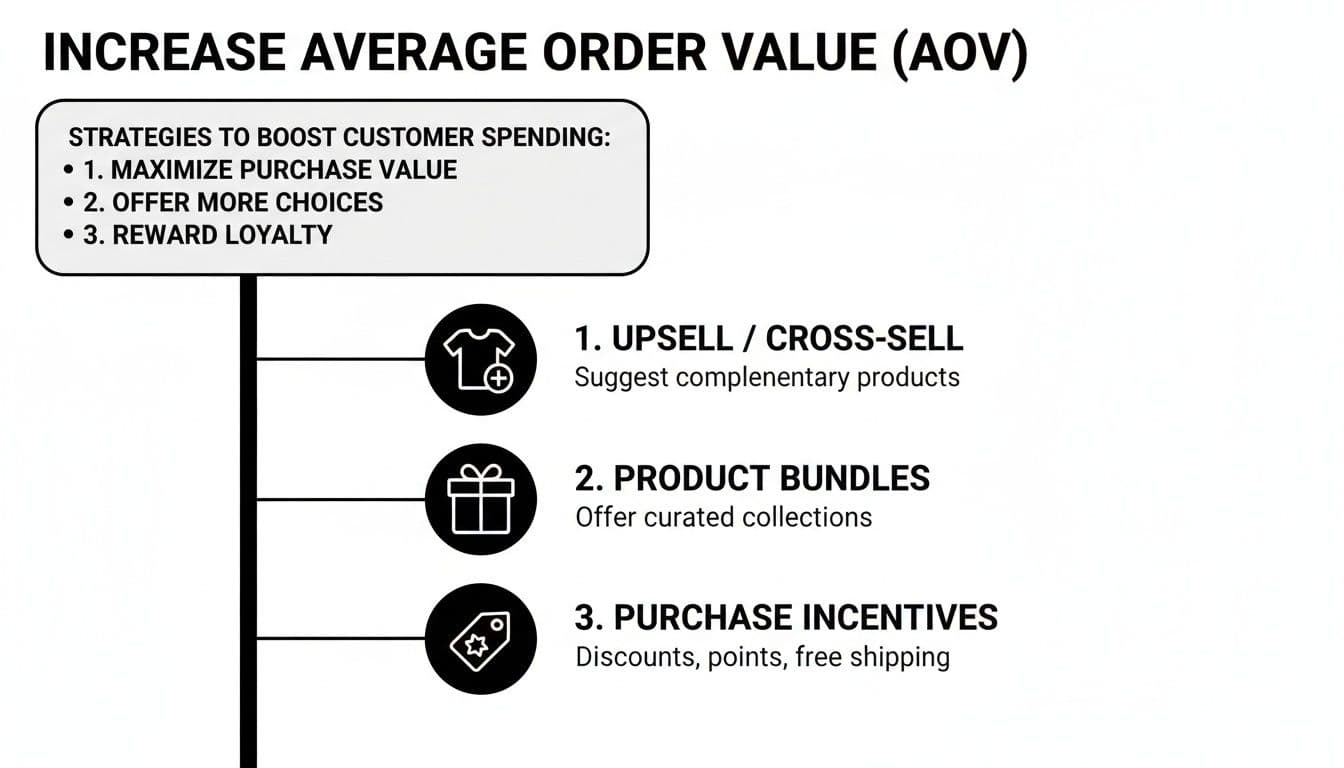
Diagram showing strategies to increase average order value (AOV) through upsell, bundles, and incentives.
If you want to go a bit deeper on the fundamentals before we jump into tactics, this guide on what is Average Order Value and how to grow it is a great resource for understanding the calculations and strategic importance behind the metric.
Use Visuals to Master Upselling and Cross-Selling
Upselling and cross-selling are, without a doubt, two of the quickest ways to boost your average order value. But let's be clear: this isn't about shoehorning products into a customer's cart. The magic happens when you anticipate a shopper's needs and present genuinely valuable additions that make their original purchase even better.
The secret to making these suggestions feel like a helping hand instead of an aggressive sales tactic is all about visual context. Shoppers need to see the value for themselves, not just read a dry description.
The Art of the Visual Upsell
An upsell is your chance to guide a customer toward a more premium, feature-rich, or simply better version of the item they're already looking at. Your goal is to show them precisely why the higher-priced option is the superior choice, and your best tool for persuasion is a great photo.
Imagine a customer is looking at a standard cotton blazer. Don't just bury a link to the "wool-blend version" in the product description. Instead, show both blazers side-by-side on a model. Let high-quality images do the talking, highlighting the richer texture, the elegant drape, and the sharper fit of the premium fabric. This kind of visual comparison instantly communicates the value and justifies the price bump in a way words never could.
My Take: A great upsell isn't a hard sell; it's a value demonstration. When you visually showcase the tangible benefits of upgrading, you empower the customer to make a better, more informed choice. The lift in your AOV is just a natural result.
Elevate Cross-Selling with "Shop the Look"
While upselling is about trading up on a single item, cross-selling is about suggesting complementary pieces to round out the purchase. For fashion brands, this is a golden opportunity to go way beyond the tired, old "you might also like" carousels.
Stop just suggesting a random handbag that might match a dress. Create a complete "Shop the Look" experience. You can use an AI-powered product to model tool to generate a single, stunning image of a model wearing the entire outfit—the dress, the perfect shoes, the right handbag, and even the ideal earrings.
This simple shift turns a generic product recommendation into a personalized styling session. You’re helping the customer see the whole picture, taking the guesswork out of styling and giving them the confidence to add those extra items to their cart. It answers the question, "How would I actually wear this?" before they even think to ask it.
Here’s how you can put this into action:
- On Product Pages: Add a "Complete the Look" section right below the main product photo, showing the entire styled outfit on one model.
- In the Cart/Checkout: As a final nudge, display a small visual of a suggested accessory—like a belt or scarf—that pairs perfectly with something already in their cart.
This approach feels less like you're selling and more like you're offering genuine style advice, which is infinitely more effective.
In the fast-paced world of online fashion, visuals drive decisions. We've seen brands that invest in high-quality product imagery achieve incredible boosts in AOV. In fact, the fashion and apparel sector's benchmark AOV hit $191 in the first quarter of 2025, leaving other categories in the dust. Smart upselling and cross-selling alone can increase AOV by 10-30%. Modern AI tools that generate studio-quality model photos in seconds are a game-changer, helping brands slash production costs by up to 90% and get products online faster. This directly improves AOV by driving better conversions and creating more compelling upsell opportunities. If you want to see the data for yourself, check out these 2025 e-commerce benchmarks to see how visuals are shaping the industry.
Create Compelling Product Bundles and Kits
Product bundling is a classic, high-impact strategy for boosting your average order value, but the real magic happens when you stop thinking about it as a simple "buy one, get one" deal. The goal is to shift your customer's mindset. You're no longer just selling individual items; you're selling a complete solution or an entire experience.
Instead of just selling a pair of leggings, you’re selling the confidence of a "Complete Workout Starter Kit." This is how you transition from being just another product retailer to becoming a lifestyle curator for your customers.
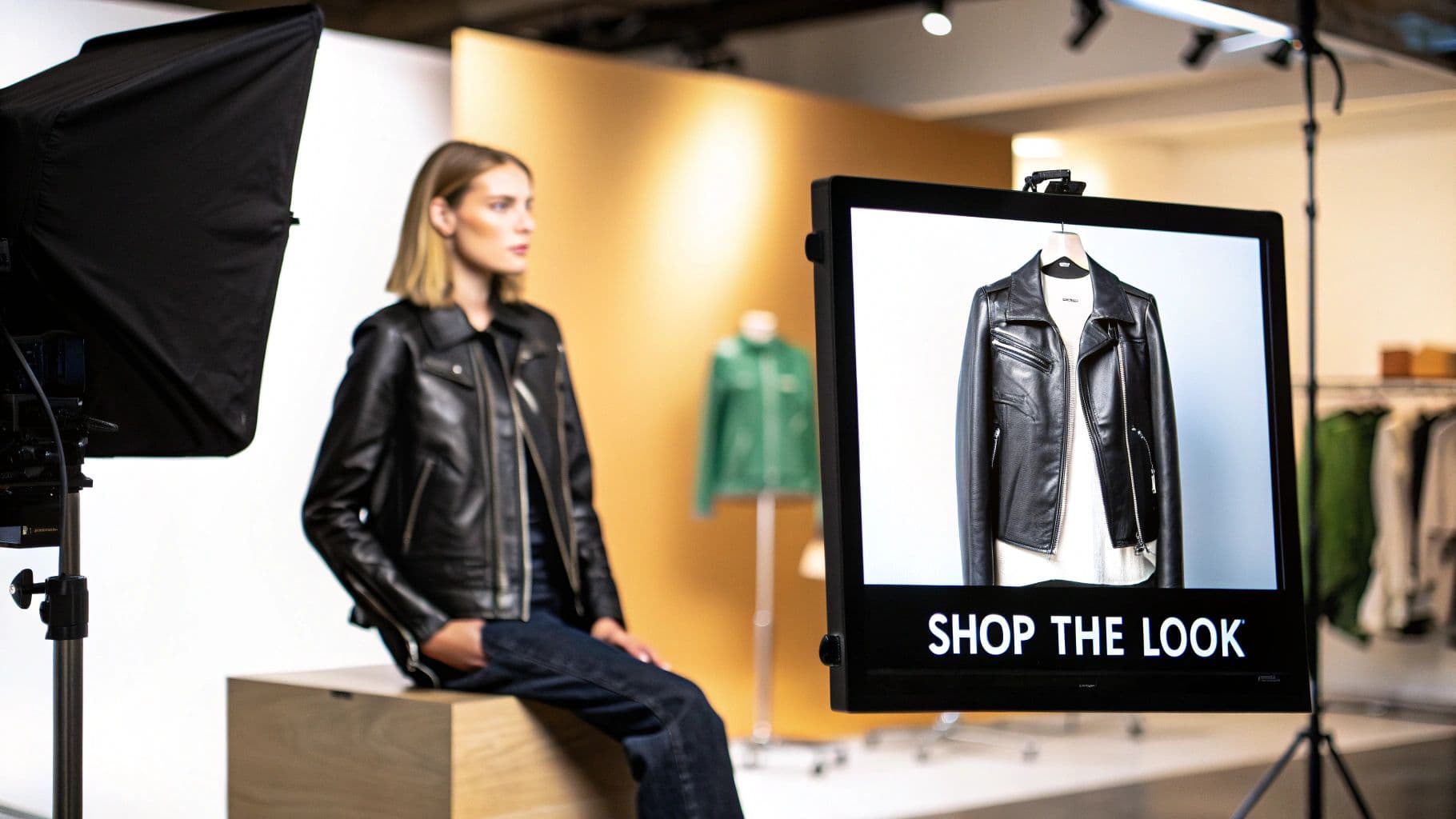
Woman in a black leather jacket in a studio with a monitor showing 'Shop the Look' fashion.
Go Beyond Basic Bundling Strategies
Great bundles are built on understanding what your customer actually wants and delivering it with incredible perceived value. They solve a real problem or fulfill a desire in one convenient package, usually with a small discount that makes the purchase feel like a no-brainer.
Here are a few bundle types I’ve seen work exceptionally well in fashion:
- The "Starter Kit" Bundle: This is about convenience. Group essential items for a specific activity—think leggings, a moisture-wicking top, and performance socks for a new runner. You're selling a ready-to-go solution, taking all the guesswork out of it.
- The "Mix-and-Match" Pack: This is a fantastic way to increase units per transaction on your bestsellers. Offer a slight discount for buying a three-pack of basic tees in different colors, for example. It’s an easy yes for the customer.
- The "Curated Collection" Bundle: This is where you sell an aspirational look. Assemble a themed outfit for an occasion, like a "Summer Vacation Edit" featuring a sundress, sandals, and a sun hat.
The common thread here? The bundle has to feel more valuable than the sum of its parts. It simplifies the shopping experience and gives the customer a clear path to a larger, more satisfying purchase.
Make Your Bundles Visually Irresistible
The single biggest mistake I see brands make with bundles is presenting them as a boring checklist. A text list like "Vintage Jacket + Denim Jeans + Classic Sneakers" has zero emotional appeal. Customers can’t picture how the pieces look together, so the offer completely falls flat.
This is where visual merchandising becomes your superpower. Instead of coordinating a complex, expensive photoshoot for every possible bundle combination, modern brands are using AI to solve this problem. You can upload individual product shots—even simple on-hanger or flat-lay photos—and generate a single, cohesive on-model image in seconds.
A visually unified bundle transforms a random assortment of products into a curated, must-have outfit. When shoppers can see the complete look on a model, the value proposition clicks into place instantly.
This visual proof is what makes the bundle so tempting. It shows the customer the outcome they're buying, not just a pile of components. This approach is a proven powerhouse for elevating AOV in fashion. In fact, direct-to-consumer brands using these visual strategies often see an AOV 2-3x higher than Amazon's typical $35.
With the fashion and apparel AOV averaging $191 in early 2024, tools that showcase complete looks are essential. For instance, a platform like WearView allows a boutique to upload on-hanger shots and generate diverse model visuals almost instantly. This makes it effortless to display a vintage jacket paired with jeans and sneakers in one scene, prompting cart additions that can boost order value by 10-30%. You can learn more about these powerful e-commerce benchmarks and the impact of visuals.
Smart Pricing for Profitable Bundles
While the visual appeal gets the customer’s attention, the price is what seals the deal. Your bundle pricing needs to hit that sweet spot: it must offer a clear, tangible discount to the customer while still protecting your profit margins.
Here’s a simple framework I use for pricing bundles:
- Calculate the Total Individual Price: Add up the retail price of every single item in the bundle.
- Determine Your Desired Margin: Understand the cost of goods sold (COGS) for the entire bundle and set a target profit margin you're comfortable with.
- Offer a Compelling Discount: The discount should feel like a real deal—I find that somewhere between 10% and 20% off the total individual price usually works best.
- Display the Savings Clearly: This is critical. Always show the original combined price crossed out next to the new bundle price (e.g., "
$250$215 | You save $35!"). This transparency makes the customer feel smart for choosing the bundle.
By combining curated product selections, stunning on-model visuals, and intelligent pricing, you can turn product bundling into one of the most reliable and effective tactics in your toolkit for increasing average order value.
Set Smart Spending Thresholds for Incentives
Offering the right incentive at the right time is a classic, powerful way to bump up your average order value. It's all about simple psychology: you give shoppers a compelling reason to spend just a little more than they planned by rewarding them when they hit a specific spending target.
This isn't about throwing random discounts at the wall to see what sticks. It's a calculated move that plays on a customer's desire to get the best deal possible. When someone sees they're just a few dollars away from unlocking free shipping or a special gift, that fear of missing out (FOMO) kicks in hard, often motivating them to find one more item for their cart. The trick is making that target feel both exciting and totally achievable.
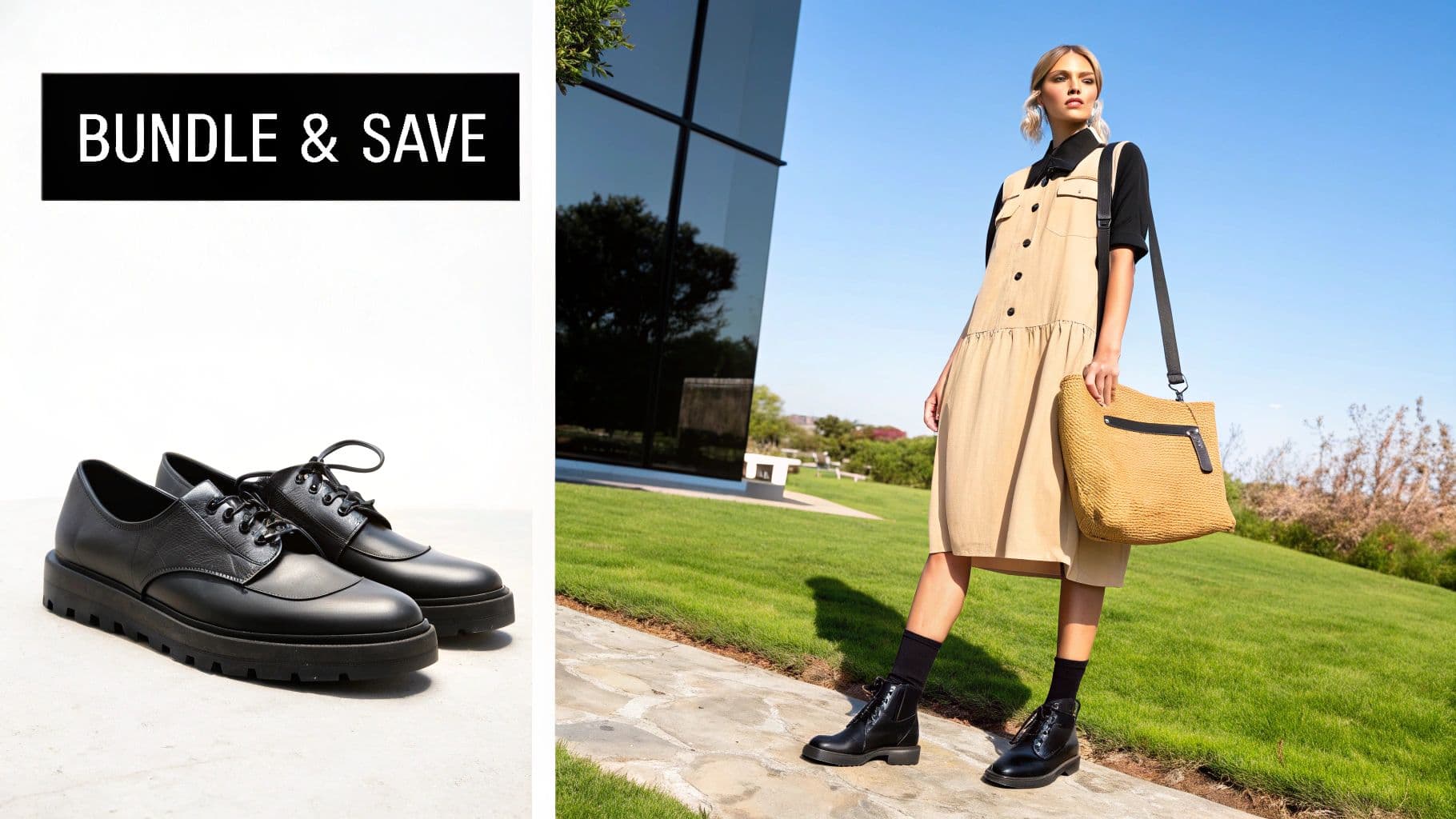
A pair of black chunky sole shoes and a woman's fashion outfit with a 'BUNDLE & SAVE' banner.
Calculate the Perfect Free Shipping Threshold
Let's be honest, free shipping is probably the most effective incentive out there. We all know that unexpectedly high shipping costs are a top reason people ditch their carts. So, turning that major pain point into a reward is a surefire way to lift your AOV.
But you have to find the sweet spot. Set the threshold too low, and you’re just eating into your margins. Set it too high, and you’ll scare shoppers away.
I've found the magic number is usually 10-20% above your current average order value.
Here’s a quick and dirty way to find your ideal number:
- Find Your Current AOV: Just divide your total revenue by the number of orders from the last month or two. Let's say your AOV comes out to $85.
- Add 10-20%: A 15% bump on $85 is about $12.75. That puts your target threshold right around $98.
- Round It Out: People respond better to clean, whole numbers. Round that up to something psychologically appealing, like $100.
This simple strategy gently nudges that customer who was about to spend $85 to go find a small $15 item, pushing both their cart value and your AOV over the line.
Use Dynamic Messaging to Create Urgency
Once you've nailed down your threshold, you need to make it front and center. Don't just stick it in a banner at the top of the page and hope for the best. You need to weave dynamic messaging directly into the shopping experience, especially on the cart and product pages where decisions are being made.
Use clear, encouraging language that shows shoppers exactly how close they are. A progress bar or a simple line of text that updates in real-time is incredibly effective.
- "You're only $15.20 away from free shipping!"
- "Add one more item to unlock your free gift!"
This creates a sense of momentum and almost gamifies the experience. It turns the journey to a higher AOV into a fun mini-challenge for the customer.
Go Beyond Shipping with Tiered Incentives
While free shipping is a classic for a reason, it's not your only play. Tiered incentives can be even more powerful because they give customers multiple goals to shoot for, which means you can appeal to people at different spending levels. It creates a "ladder" of value that encourages shoppers to keep climbing.
A well-structured tiered system makes every customer feel like they're getting a great deal, whether they spend a little or a lot. It’s about creating multiple winning scenarios that all lead to a higher AOV for your brand.
Think about a multi-level structure that rewards bigger carts with better perks. You can splash this across your site with eye-catching banners that clearly spell out the value at each stage.
Example Tiered Discount Structure:
- Spend $100+: Get 10% Off Your Order
- Spend $150+: Get 15% Off Your Order
- Spend $200+: Get 20% Off + a Free Gift
A gift-with-purchase is another fantastic motivator. Instead of a discount, offer an exclusive or high-value item once a cart hits a certain amount. The key is to make the gift feel like a genuine reward, not just a cheap throwaway. For instance, a fashion brand could offer a stylish tote bag for orders over $150. Just be sure to show off that free gift with high-quality images right in the promo banner to make it feel tangible and desirable.
Put AI to Work with Personalized Recommendations
Person types on a laptop showing 'Unlock free shipping' with a shopping cart icon, surrounded by shipping boxes.
If you've maxed out broad incentives like free shipping, it's time to get personal. The "best-sellers" and "trending" carousels just don't cut it anymore. To really get shoppers to build bigger carts, you have to show them products that feel like they were picked just for them. This is where AI completely changes the game.
AI recommendation engines are brilliant because they see everything. They track browsing history, past purchases, what's been left in the cart, and even how long someone looks at a specific product. This data allows you to serve up recommendations that are genuinely helpful, turning a generic "you might also like" section into your hardest-working sales tool.
Go from Suggesting Products to Styling Outfits
The real breakthrough isn't just showing a shopper five more blue sweaters. It’s understanding they're building an outfit. A smart recommendation engine will suggest the perfect pair of jeans, a complementary scarf, or the right boots to go with that sweater.
Think of it as having a personal stylist for every single visitor on your site. The system anticipates what they need next, solving that all-too-common "what would I even wear this with?" dilemma. It makes adding more to the cart feel less like an upsell and more like a genuinely helpful suggestion.
Brands that really nail this see incredible results. We're talking 20–30% increases in sales for companies that execute a cohesive personalization strategy. It’s a direct line to a higher AOV because you’re showing the right product to the right person at exactly the right time.
Why Visuals Make AI Recommendations So Powerful
The real magic kicks in when you combine intelligent recommendations with next-level visuals. It’s one thing to tell a customer that a blouse would look great with the skirt in their cart. It’s something else entirely to show them.
Imagine your shopper is looking at a recommended top. With AI-powered tools like WearView, you can instantly generate a new on-model image showing that exact top styled with the skirt they're about to buy. This visual confirmation is a huge confidence booster. Suddenly, they aren't just buying two separate items; they're buying a complete, styled look they can already see works perfectly.
You can even take it a step further and generate visuals on a model that reflects the customer's personal aesthetic, making the recommendations feel incredibly tailored. If you want to dive deeper, our guide on the best AI tools for fashion brands is a great place to start exploring the technology out there.
Build Purchase Confidence with Virtual Try-On
Virtual Try-On (VTO) is the ultimate tool for overcoming the hesitation that leads to abandoned carts. It lets shoppers see how a new piece looks on their body type or, even better, how it pairs with other items.
This opens up some fantastic opportunities to grow order value:
- Complete the Look: A customer can virtually "try on" a recommended blazer over the dress that's already in their cart to see if the pairing works.
- Build an Outfit from Scratch: A shopper could upload a photo of their favorite pair of jeans from home and see how different tops from your store look with them.
This isn't just about reducing returns; it's about actively encouraging customers to build bigger baskets. By showing them how seamlessly new pieces fit with their current cart or their existing wardrobe, you give them the confidence to buy the whole outfit, not just one piece. It’s the most effective, personalized cross-sell you can offer.
Optimize Your Checkout and Post-Purchase Flow
Think of the checkout process as the final handshake. It's the last, and arguably most critical, moment you have with a customer. So many brands miss a huge opportunity here to increase the average order value simply because they're afraid to get in the way.
Once a shopper has decided to buy, their intent is at its peak. This is the absolute best time to slide in a compelling, easy-to-accept offer. The trick is to do it without creating friction. Every extra form field, every unexpected shipping cost, every confusing step is another reason for them to abandon their cart. Your goal should be a checkout so seamless that adding one more thing feels like a no-brainer.
The Power of the Post-Purchase Upsell
This is exactly why one-click post-purchase offers are so effective. Instead of cluttering the main checkout page and risking the original sale, you wait until after the payment has gone through. On the confirmation screen, you present a related offer that the customer can add to their order with a single click—no need to re-enter payment or shipping info.
This strategy works because it catches customers when they're most excited and trust you the most. They've just committed. The mental barrier to add one more relevant item is incredibly low. I've seen brands boost their AOV by an average of 5.6% just by implementing a smart post-purchase offer.
By separating the core purchase from the additional offer, you secure the initial conversion first. Then, you present a bonus opportunity. It’s a low-risk, high-reward play that every store should be running.
The best post-purchase offers are always:
- Highly Relevant: Think matching accessories, a care kit for the item they just bought, or a smaller, complementary product. It has to make sense.
- Time-Sensitive: Frame it as a one-time deal. Something like, "Add these matching earrings now for 20% off—you won't see this offer again!" creates genuine urgency.
- Visually Appealing: Show, don't just tell. This is a perfect spot to use an ai fashion video generator to quickly create a dynamic shot of the add-on item being worn or used.
Weave Loyalty into the Final Step
Another clever tactic is to integrate your loyalty program right into the checkout flow. As a customer is about to pay, show them exactly how many points they're about to earn. Then, give them a little nudge.
Show them how close they are to the next reward tier. A simple message like, "You're only $12 away from reaching VIP status and unlocking 100 bonus points!" can be incredibly persuasive. It reframes a small add-on purchase as an investment in future rewards. This not only boosts the immediate AOV but also deepens customer loyalty, giving them a reason to come back and climb that ladder.
Frequently Asked Questions About AOV
Even with a great plan in place, questions always come up when you get into the weeds of AOV optimization. Let's tackle a few of the most common ones we hear from e-commerce pros.
What Is a Good Average Order Value for a Fashion Brand?
It really depends on your niche, but a solid AOV for direct-to-consumer fashion brands usually lands somewhere between $150 and $200. To give you a recent benchmark, the average for fashion and apparel in Q1 2025 was $191.
But here's the thing: "good" is all relative. The most important metric is how your AOV stacks up against your customer acquisition cost (CAC). Your AOV needs to be comfortably higher than your CAC to keep your business healthy. The real game is to focus on beating your own numbers, month after month.
How Often Should I Test New AOV-Boosting Strategies?
Honestly? You should always be testing something. The trick is to isolate your tests so you know what's actually working.
Roll out one new strategy at a time. For instance, you might introduce a free shipping threshold and let it run for a full month to gather clean data. Only after that should you start experimenting with a new product bundle on your best-selling items.
A/B testing tools are your best friend here, allowing you to experiment with different offers, visuals, and placements without guessing. A quarterly review of your AOV performance and strategy is a great rhythm to get into. If you're looking for more ideas to test, this UK merchant's playbook on how to increase average order value is packed with solid tactics.
The key is to add value, not friction. Strategies like offering relevant cross-sells, visually appealing bundles, and achievable thresholds typically increase AOV without harming conversion rates. Always monitor both metrics in tandem to find the right balance for your brand.
It's a delicate balance. Pushing too hard with aggressive upsells or setting a free shipping goal that feels miles away can backfire, spooking customers and leading to abandoned carts. That’s why testing is non-negotiable.
Ready to turn your flat product shots into on-model visuals that actually sell? WearView uses AI to generate stunning, studio-quality fashion imagery in seconds. You can create irresistible bundles and showcase every single look flawlessly—without the photoshoot budget.
Start boosting your AOV today. Visit https://wearview.co to begin your free trial.
Tags:

WearView Team
WearView Content & Research Team
WearView Team is a group of fashion technology specialists focused on AI fashion models, virtual try-on, and AI product photography for e-commerce brands. We publish in-depth guides, case studies, and practical insights to help fashion businesses improve conversion rates and scale faster using AI.